Sunday, 27 January 2013

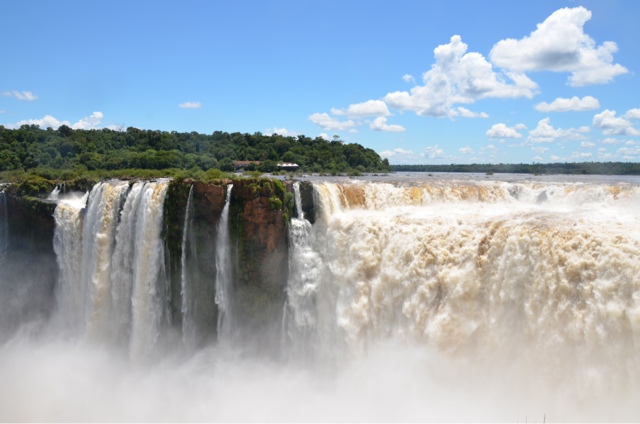
Viewing Iguazu Falls from Argentina

Enormous
Picturesque
Iguazu Falls
Coatis

Iguazu Falls consists of 275 individual falls, occupying 3km wide and 80m high - which is wider than Victoria, and higher than Niagara. Plus having seen the former, they are by far more beautiful and picturesque. The falls are unequally shared by Argentina and Brazil, Argentina claims the majority. Parque National Iguazu in Argentina provides an up close and personal experience of individual falls, whereas Parque National do Iguacu in Brazil offers a more panoramic view of the 275 falls.

Argentine access to this natural wonder, is by a Rainforest Ecological Train which brings visitors to the entrance of Devil's Throat, as well as the upper and lower circuits. Circuito Superior is the least spectacular with views from the tops of the falls. Circuito Inferior is a 1.5km walk offering pretty views from below the falls. Paseo Garganta del Diablo is a 1-kilometre-long trail that brings you directly over the falls at the Devil's Throat, the highest and deepest part. At this point the serene river turns violent: 13,000 cubic meters of water per second plunge 90m in 14 falls around the horse shoe canyon. Watching this section was a truly hypnotising multisensory experience - hearing the roar of the water, getting soaked by the enormous spray, and simply seeing the power of the gushing water; utterly mesmerising!!!

We ate lunch at a cafe near the top of the falls. The eating area was swarmed with begging, cheeky coatis. One of whom jumped up on our table in an effort to grab an opportunistic free lunch. Unfortunately for the coatis Heather is quite partial to her food and you don't want to get between her and it at any stage. The coatis were sent scampering after getting big smacks on the nose from a plastic tray.




Ruined Jesuit Missions in Posadas

Enticing
Posadas
Indians
Caipirinha

While we found ourselves in Posadas we decided it was time for a bit of cultural sightseeing. We headed off and see the ruined Jesuit missions in the area. The missions were self-sufficient settlements of native Guarani Indians who lived, and worked, under the tutoring of a small number of Jesuit priests.

Santa Ana is a crumbled mission set in jungle vegetation and was the site of the Jesuit iron foundry. Building walls still stand and steps lead from the church to the plaza.

The best preserved Jesuit mission, showing the most inside glimpses of its former splendour, is also the largest, San Ignacio Mini, founded in 1696. The plaza and church ruins are made from a reddish sandstone and looked beautiful on the sunny day that we were there.

Staying at the campsite in San Ignacio we were introduced to an enticing fruit flavoured drink called Caipirinha. This is Brazil's national cocktail, made with cachaça (sugar cane rum), sugar and lime, and we figured that since we were heading to Brazil in the coming days it would be of benefit to check out their favourite tipple. While the lime concoction was nice, I was more a fan of the Caipifruta consisting of cachaça, crushed fresh fruits (either singly or in combination), and crushed ice. Nice ones being passion fruit & mango, and peach & orange.

The Caipirinhas led to quite a few sore heads as it turns out servers don't believe in measures and just go with the force when creating them. It is virtually impossible to get two drinks the exact same. Pure rocket fuel at times! Mikkel turned barman at this camp, hopping behind the bar, making drinks and taking money under the watchful eye of the actual bar lady.


Sunday, 20 January 2013

Wildlife at Ibera Wetlands and Gaucho Gil explained

Egrets
Patron saint for travellers
Ibera
Capybaras

Reserva Provincial Esteros del Ibera is the next stop, a large wetland reserve home to numerous bird and animal-life. Saw black Caimans (type of crocs) bask in the sun, and Capybaras (giant guinea pigs) roam freely. There are also over 350 types of bird here, kingfishers, egrets, heron, cormorants, vultures; shame I am not doing 'a big year' eh?

BTW had my first critter-shower experience. On turning on the shower the nozzle was on the bath spout setting and out popped a little frog into my awaiting hands. He was a fast and jumpy little beggar. Proud to say I didn't shriek, but he did get a very wary eye cast on him and Christ could he leap from wall to wall. No doubt this will not be my last such experience.

We did a boat trip around Laguna Ibera and its embalsados, saw loads of wildlife and watched a beautiful sunset. The sun plummets from the sky over here - blink and you miss it like!

Leaving the campsite we stopped at a Gaucho Gil shrine. We had spotted shires with red flags all around the roadsides of Argentina and it was presumed that these were memorials to people who had died on the roads. While this can be the case for some, the red flagged shines are usually dedicated to Gaucho Gil, the unofficial Argentine patron of travellers. He was a deserter of the military in the 1870's who evaded capture for quite some time. During that time, he was a sort of "Robin Hood" figure, robbing from the rich and giving to the poor. When he was eventually captured and sentenced to death, he was hung upside down from a tree. As the executioner was preparing to behead him, Gaucho said, "If you do kill me, your son will be stricken with a deadly illness, and the only way to save him will be to give my body a proper burial." As expected, the executioner proceeded with his task and, when he arrived home, discovered that his son was deathly ill. He returned to the site of the execution and buried Gaucho's body. His son was miraculously cured and a legend was born. Now, Argentineans have built shrines throughout the country to venerate the memory of Gaucho Gil. The significance of flags and red colour are unknown, but may have something to do with either the colour of Gaucho's political party or the colour of the blood he shed. The shrines are all usually ramshackle, little more than a crate containing a statue, but all have the same purpose, a wish of safe passage for travellers.

P.S. Apologies for the lack of posts recently, but I'm reading Gregory David Roberts magnificent Shantaram. It is completely compelling and reading it is taking up all my free time, I just cannot put the book down (and it's a feckin' heavy 931 page book!). Totally going to purchase my own copy on my return. India, in my opinion, still comes across as terrifying and awesome at the same time. And the balance is definitely tipped towards terrifying!